Wednesday, August 18, 2010

Savanna-Lipstick Powderhorn

Lipstick Powderhorn

Order: Lecanorales

Family: Cladoniaceae

Genus: Cladonia

Species: C. mailenta Hoff.

General Characteristics: Tall, slender, podetia topped with small, bright red, apothecia. Podetia often thicker at the top.

Special Adaptations: Lipstick Powderhorn has a distinct chemistry, which allows some to describe it further down the chemical race. The chemical race thamnolic acid is more commonly found on rocks.

Savanna-Mullein

Mullein

Order: Lamiales

Family: Scrophulariaceae

Genus: Verbascum

Species: V. thapsus

General Characteristics: Mullein is biennial, so it lives for two years. The first year, this plant grows a rosette, but no flower stalk. The rosette survives through Winter, and the flower stalk grows the second year. At the end of the second year, the plant dies. The rosette leaves are large and soft. They are bluish-green and grow up to 12 inches long and 5 inches wide. Most people compare the soft surface of a leaf to felt.

Common Mullein flowers are yellow with five petals. Flowers are about an inch wide. They bloom a few at a time from June to September.

Special Adaptations: Mullein produce huge numbers of seeds. One mullein plant may make over 100,000 seeds in a year. Seeds can survive almost any conditions and can last up to 100 years. Since mullein can't grow in shade, the seeds can lay in the soil, waiting until plants around them die or are removed.

Savanna-Buckeye Butterfly

Buckeye Butterfly

Order: Lepidoptera

Family: Nymphalidae

Genus: Junonia

Species: J. coenia

General Characteristics: The upperside is brown. The forewing has 2 orange cell bars and 2 eyespots; part of white subapical band appears in the largest, lower eyespot. The hindwing has 2 eyespots; upper one is largest and contains a magenta crescent. The underside of hindwing is brown or tan in the wet season (summer) form and rose-red in the dry season (fall) form.

Special Adaptations: The Buckeye breeds on plants containing bitter iridoid glycosides, including plantains, various Scrophulariaceae, and Lippia. Favorite nectar sources are composites including aster, chickory, gumweed, knapweed, and tickseed sunflower. Dogbane, peppermint, and other flowers are also visited.

Savanna-Whorled Milkweed

Whorled Milkweed

Order: Gentianales

Family: Asclepiadaceae

Genus: Asclepias

Species: A. verticillata

General Characteristics: This native perennial plant is unbranched and up to 2' tall. Whorls of 4-8 linear leaves occur along the slender central stem. This stem is ridged and hairless. Each leaf is up to 3" long and 1/8" across, with a prominent longitudinal vein, and no hairs. The leaves often curve downward from the stem, and then curl slightly upward toward their outer tips. Along the upper half of the plant are short-stalked umbels of greenish white flowers that emerge from the axils of the leaves. These umbels have up to 20 flowers and span about 2-3" across. Each flower consists of 5 strongly reflexed petals that are light green, and 5 white hoods that are arranged around the center of the flower. An individual flower is about 1/3" across. There is little or no floral scent. The blooming period occurs from early to late summer, and lasts about 1-2 months. Later, slender follicles appear where the flowers have been successfully pollinated. These follicles split along one side to release numerous seeds with large tufts of white hairs. The follicles are about 3-4" long and 2/3" across, with a fairly smooth surface. Seed dispersion is by wind. The root system is fibrous and rhizomatous. This plant often forms colonies.

Special Adaptations: This little milkweed blooms later in the year than many other members of the genus, and is good at attracting butterflies. The foliage of this plant resembles a horsetail, but the flowers reveal its membership in the Milkweed family. It can be distinguished from other milkweeds by its skinny whorled leaves and greenish white flowers.

Savanna-Chinese Praying Mantis

Chinese Praying Mantis

Order: Mantodea

Family: Mantidae

Genus: Tenodera

Species: T. aridifolia sinensis

General Characteristics: A long and thin praying mantis with the colors ranging in different shades of browns. When adult, they have a green lateral stripe down the side of the wing case. They also have a small spike on the four walking legs. Being quite a large Mantis, the adult size varies from 85 - 100mm in length (Dependent on the sex).

Special Adaptations: As an organic insect control method, the praying mantis is very effective. With a voracious appetite, the mantid will feed on just about any pest insect. Introduced into the United States approximately 75 years ago, the Chinese Praying Mantis. With an enormous appetite they have been known to eat up to 16 crickets per day and consume over 21 different species of insects.

Savanna-Flower Fly

Flower Fly (Hoverfly)

Order: Diptera

Family: Syrphidae

Genus: Various

Species: Various

General Characteristics: Their size ranges from 4 mm to over 25 mm and their coloration from bright yellow or orange to dull dark black or gray with a few iridescent forms. Flower Flies are abundant on flowers, which are used as mating sites and energy sources. Hoverflies have spots, bands or stripes, of yellow, brown against a dark-coloured background, sometimes with dense hair covering the body surface (emulating furry bumble bees). Their fast flight, motionless flight and, in some species, their size are astonishing feats. Some Hovers are among the biggest flies of Central Europe. Many species are very colorful. It is not always that easy to identify hover flies. Some thick headed flies and bee flies are similar and dark coloration makes it hard to identify them correctly at a glance.

Special Adaptations: Many flower Flies are Batesian mimics of stinging wasps and bees (Hymenoptera).

Savanna-Wild White Indigo

Wild White Indigo

Order: Hemiptera

Family: Fabaceae

Genus: Baptisia

Species: B. alba macrophylla

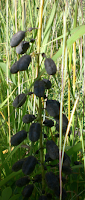
General Characteristics: This native perennial plant is about 3-6' tall and forms an erect, sparsely branched bush, although it is herbaceous. The stout central stem and upper side stems are smooth, light green or reddish purple, and glaucous. The compound leaves are trifoliate. They are usually greyish green or blue green, and hairless. Each leaflet is ovate or oblanceolate and pointed at both ends, with smooth margins, and about 2" long and ¾" across. The white flowers occur in erect spike-like racemes up to 2' long and are quite showy. They are typical pea flowers in overall structure, and about 1" long. There is no floral scent. The blooming period occurs from late spring to mid-summer and lasts about 1-1½ months. The flowers are replaced by large oblong seedpods, which are also rather showy. They are about 2" long and initially green, but later turn black. There is a stout deep taproot, and rhizomes that may form vegetative offsets. Once established, White Wild Indigo grows very quickly during the spring – it often towers above the surrounding plants by blooming time.

Special Adaptations: Native Americans used Baptisia tinctoria root to treat a wide range of maladies. Wild indigo preparations were applied externally to disinfect wounds and soothe inflammations, and ingested as a remedy for venereal disease, pain, and liver and kidney problems. Their use of wild indigo to create a weak blue dye inspired the nickname “false indigo”. Wild indigo was also once known as “horsefly weed”, as farmers discovered that tying bunches of the plant to horses kept insects at bay. Doctors in the late 1800s-early 1900s recognized the potential of wild indigo to combat deadly illnesses, notably typhoid, smallpox, and scarlet fever . Botanical literature from this period documents Baptisia tinctoria as a treatment for ulcerations, gangrenous wounds, upper respiratory infections, and mouth sores, and states that it also fortifies red blood cells and promotes the flow of bile and digestive juices.